
V2 Owning The Acoustic Guitar (Intro)
Introduction
I believe I had a natural sense of rhythm to begin with, and I suspect the same is true for you. My beginnings somewhat forced me into it and I didn't resist the curiosity. Growing up around drummers and staying obsessed with music certainly helped me understand and develop it over time. I would watch my father use his steering wheel as a hand drum during car rides. He would practice complex rudiments using his turning signal as a metronome while waiting at stop lights. He would also take me to see African music live in Toronto while other children were exposed to only what was on TV and in the radio. I am proud of my inner groove, but I also had to work hard to refine it.
I thought my tempo was solid—until the first time I met a metronome.
Suddenly, my playing became stiff. I was trapped in my head, thinking about the timing instead of living inside it. My rhythm was good, but it lacked flexibility. It took me years to develop a real relationship with the metronome—to learn how to treat it like a fellow musician rather than a militant robot. I found myself playing with shaker loops instead of dry clicks. I started using 8th notes so I could hear the "in-betweens." Even to this day, as a human being, I can still get tripped up by tempo and pitch from time to time.
Tempo and pitch share an interesting relationship. Although modern tools can easily correct them, we quickly notice a loss of soul and character when we force them to be absolute. Our humanity and musicality live right on that edge—the space between striving for perfection and just being human.
Rhythm is the authentic signature of who we are. It is the power to get people out of their seats, ready to move with you. It is the connection to your inner self that invites the rest of the world to come in and play along.
The rhythm of music is much more psychological and spiritual than it is theoretical. Here we will go over the vast network of playing and documenting time as a singer-songwriter. We are going to focus less on the written aspect of timing and more on the physical and psychological approach to achieving your best results as a rhythm guitarist and vocalist.
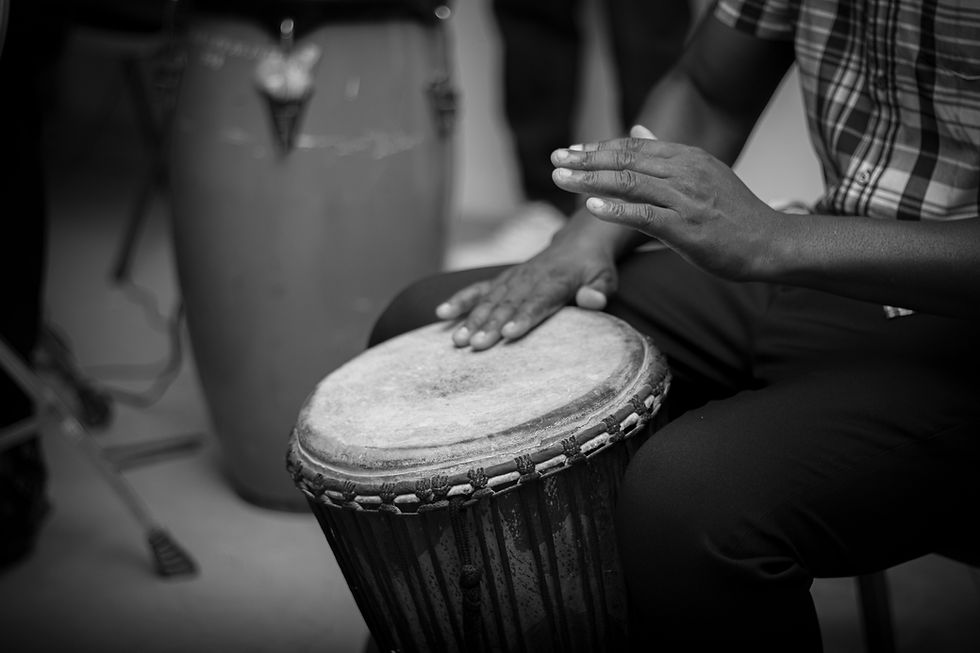
The guitar is sometimes described as just “a drum with strings”. I found that playing a hand drum or other percussive instruments like a shaker or tambourine can really help translate back to the guitar. Each one of us has our own unique rhythm and the best approach to finding it is simply by experimenting with numerous approaches. Some guitar players like to even hit their guitars on the wood or strings to parrot the sounds of a drumset or conga. Personally, I approach my strumming similar to a shaker but through the art of finger picking and strumming I learned it is more and more like a hand drum - where the fretting hand is just as rhythmic as the strumming hand is. Both hands work synergetically to one another.


Comments